

These are the messages that inspire us to continue to do what we do.
“Hello, Mary. I wanted to let you know that Zoe left us a week ago. We are broken hearted. I still can’t believe it. I know you will understand.
I wanted to thank you because I know that Zoopharmacognosy helped her right to the end.
She did not need any medication until the last 20 days and she fought to the very end.”
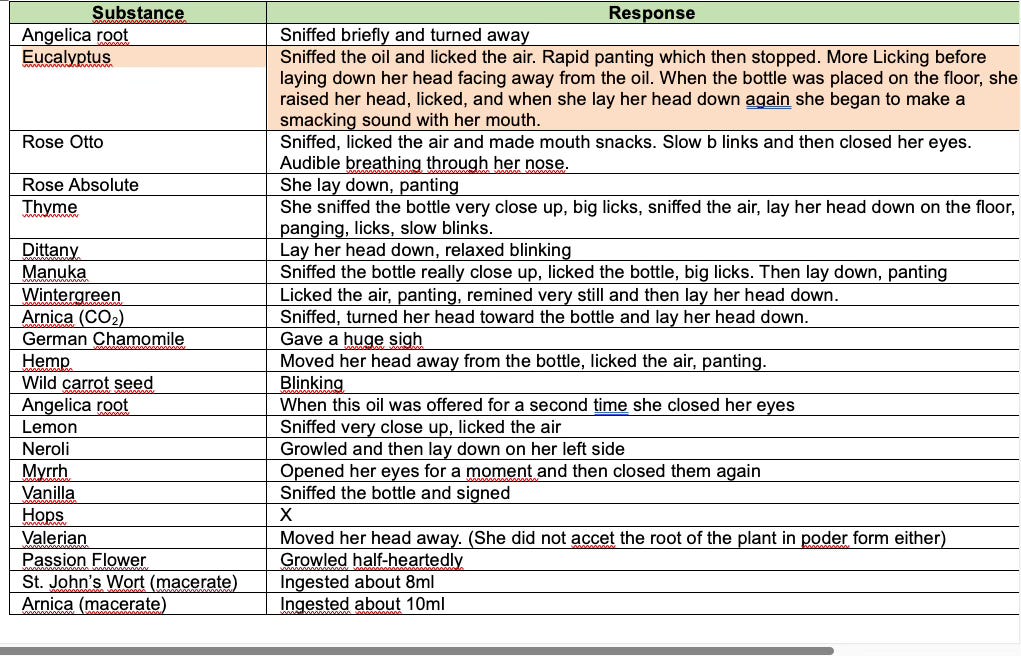
I met Zoë at the beginning of this year (2026) when her family called to ask whether I could do a zoopharmacognosy session with her. Below you can see her health history and how the session evolved.
Zoopharmacognosy Session 10/01/2026
Age: 11 years
Breed: Australian sheep dog
Background
Zoë is a female Australian sheepdog who will be 11 in May. She has always been very nervous and is constantly on alert. In the past she has had very strong renal and digestive problems.
She was recently diagnosed with a tumour in her left nostril which is now completely blocked. Neither her brain nor he reyes are affected. The treatment suggested are very aggressive and would be very traumatic for Zoë as she would have to travel long distances. Furthermore, the secondary effects of the medication could aggravate or reignite the renal and digestive problems she has suffered from in the past.
After. Much consideration, the family decided that their goal was to give her the best possible quality of life for her remaining days.
Suggestions
Essential Oils
Based on Zoë’s responses, I would suggest offering her the following oils:
· Eucalyptus
· Thyme
· Manuka
· German Chamomile
· Neroli
· Lemon
· VanillaManuka essential oil might be difficult to find here, but the other oils are widely available and are mostly inexpensive. The only exception might be German Chamomile but I think you already have that.
A few drops of the lemon oil may be applied to the left side of her nose just before going out for a walk as the oil’s ability to inhibit the growth of the capillary network of the tumour is activated when the oil is exposed to ultraviolet light.
Macerated Oils
Both St John’s Wort and Arnica macerates may be offered for Zoë to ingest.
Los aceites macerados, tanto de hipérico como de árnica, se pueden ofrecer para ser ingeridos.
As you know the first dose of St. John’s Wort which we have given today should always be limited. Now you should observe her over the next. 24 hours to see f there is any somnolence. After 24 hours Zoë can dose herself.
Dried Substances
Spirulina
Spirulina is recommended because it can support and strengthen the immune system.
Green Clay
Green clay may be applied directly on the nostril. It will work best if you make it into a paste by adding wáter.
Turmeric
I did not have any turmeric today but the powder is easily available in health shops . On some websites you can buy “Golden paste” but if you follow Dr. LaValley ‘s instructions you can make it yourself at home.
Here is a translation from the relevant section of my book (in Spanish) Libre Elección”.
Cancer
One of the most studied areas in the role of turmeric in the treatment of cancer, and Dr. William LaValley is one of the foremost figures in this field. One very interesting point is that it appears that turmeric is effective against all kinds of cancers. This is quite remarkable because cancer covers a wide range of molecular pathologies. Turmeric can destroy cancerous cells and at the same time promote healthy cellular function. Furthermore, it helps prevent tumours from extending their capillary network, which is crucial for tumour growth. Once inside the cell, turmeric affects over 100 molecular pathways. It is important to point out that turmeric does not have any adverse effects on healthy cells, which suggests thst it targets canerous cells specifically.
How does it act
One of the mechanisms of turmeric is very similar to that of vitamin D: it modulates a great number of genes. Turmeric modulates approximately 700 genes. Other studies have shown that turmeric acts by entering the cell membranes where it modifies the physical properties of the membrane re-establishing a more orderly structure.
Instructions for Use
Ingesting the crude root powder is not the most effective method of taking advantage of the properties of turmeric. Dr. LaValley suggests preparing a microemulsion as follows:
· Mix 1 soupspoon of turmeric powder with 1-2 eggs (eggs are very bioavailable) + 5-10ml. of coconut oil
· Whisk the mixture.
This can be offered to the sick animal 3-4 times per day. Se puede ofrecer 3-4 veces al día al animal enfermo. When working in the field of zoopharmacognosy, we must remember not to force animals to accept any substance against their will.
As turmeric stains, we must be careful not to spill it on clothing, upholstery etc.
The Australian vet, Dr. Doug English, is an expert in the use of turmeric and he even has his own plantation. His website is a mine of useful information: www.turmericlife.com.au
Warning
· Turmeric should not be offered to animals with gallstones or gallbladder obstruction.
Environment
Non-human animals tend to live mostly in the present whereas we humans tend to revisit the past and Project into the future which means that we often imagine scenarios which never materialise. Therefore, as Zoë is so hypersensitive to everything which occurs in her environment, I would like to suggest that you try to project and create as positive and serene atmosphere as possible. I know that this is not easy but it would be the best thing for Zoë and also for your unborn baby.
Feedback
That same afternoon I received a message to say that after the session Zoë had. Fallen asleep and when she woke up she was very happy and contented.
Run free, Zoë!


